The Fine Art of Standing Still: A Cheekie Field Guide to the Great British Queue
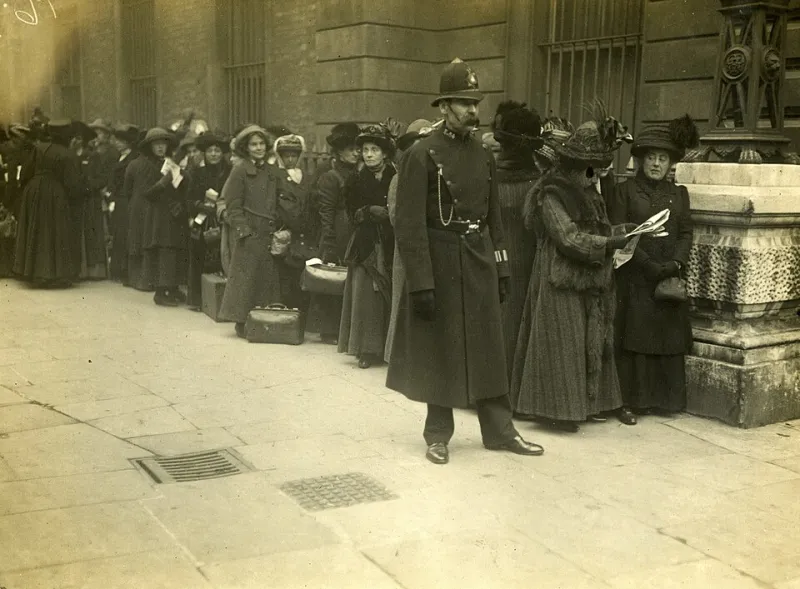
Photo: Unknown, No restrictions, via Wikimedia Commons
Britain does not have a national anthem so much as a national shuffle forward. We queue for buses, for pasties, for gallery exhibitions, for a portaloo at a festival. We queue for the privilege of possibly getting a ticket to queue again. In 2026, with pop-ups appearing faster than you can say ‘limited drop’, and festival tickets vanishing in a digital blink, the queue remains our most reliable social institution. It is also our most quietly ruthless.
Why We Join: The Magnetic Pull of a Loose Crowd
There is a moment, walking past a shop or a stall, when you see a loose gathering of people and your legs make a decision before your brain does. You slow down. You crane your neck. You think, ‘Is that a queue?’ It might be a queue for a new bakery, a book signing or a man selling unusually good cheese. It might just be a group of people waiting for a friend. But the British instinct is clear: if two or more are standing in a line, there is probably something worth having at the end of it.
This is not blind obedience. It is optimism. A queue is a promise that something good is coming, even if that something is a lukewarm coffee and a pastry you could have bought elsewhere. It is also a chance to do our favourite quiet activity: observing other people while pretending to look at our phones.
The Queue Taxonomy: Sighers, Placeholders and Space-Invaders
Every queue has its characters. The Sigher is easy to spot: a dramatic exhale every ninety seconds, followed by a glance at a watch they already checked. The Sigh is not really about the wait; it is a warning shot to anyone thinking of pushing in.
The Placeholder is a master of the coat-on-the-floor manoeuvre. A jacket, a bag or a single empty coffee cup reserves a spot while its owner goes in search of a loo, a snack or a better queue. The rule is one person, not a coach party. If you are saving a place for seven friends who are ‘just parking’, you are not a placeholder; you are a branch office.
Then there is the Space-Invader, who stands so close you can tell what they had for breakfast. They believe the gap in front is an invitation, not a boundary. They are wrong, but they are persistent. And finally, the Researcher: the person who walks the entire length of the queue to see if it’s moving, then returns to report, ‘It’s the same.’ Thank you, Researcher. Your service is noted.
The Unwritten Rules (and the Ones That Cause Quiet Outrage)
The first rule is simple: join the back. Not the middle, not the bit near the door, not the suspiciously short section that turns out to be the queue for the bins. The back is sacred. The second rule is: do not overtake without a genuine reason and a clear apology. ‘Sorry, I’m just joining someone’ is acceptable if the someone is actually there. It is less acceptable if the someone is a figment of your imagination and a vague wave.
Maintain a respectful distance. Close enough to show you’re in the queue, far enough that you’re not breathing on a stranger’s neck. Prepare your payment before you reach the front. Have your ticket ready. Know what you want. The queue does not reward the person who reaches the till and suddenly discovers the concept of choice.
And be kind to staff. The queue is not their fault, even if they are the only person serving. The Sigher who tuts at a barista is not a hero; they are a weather system with a loyalty card.
Merging, Holding and the Sacred Placeholder
Queues that merge are the advanced class. Two lines become one, and someone must decide who goes first. The correct move is the zipper: one from the left, one from the right, no sudden lunges. Do not pretend you didn’t see the other line. Do not accelerate to close the gap. The zipper is civilisation in miniature.
Holding a place is allowed, within reason. A coat, a bag, a friend who is already there — fine. But the placeholder must be honest. ‘My friend’s just coming’ is a promise, not a magic spell that summons a group of ten from the car park. If your friend is not coming, you are a solo queue with extra admin.
Queue Survival for 2026: Pop-Ups, Festivals and Ticket Drops
This year’s queue is not always a physical one. Ticket drops and pop-up reservations have given us the virtual queue: the loading screen, the numbered position, the ‘you are 4,832nd in line’ message that feels like a personal insult from the internet. The same rules apply. Do not refresh like a maniac. Do not open five tabs. Do not tell everyone you know to join ‘just in case’. The virtual queue can smell panic.
For real-world queues, pack for a mini expedition: a portable charger, a snack, a waterproof layer and a bottle of water. Not too much water, unless you enjoy the particular challenge of leaving the queue to find a loo and then rejoining at the back. Wear comfortable shoes. Bring a book or a podcast. And if you’re in a festival queue, accept now that you will be standing still for longer than you thought possible while someone behind you explains their entire festival itinerary.
When to Break Rank (Almost Never)
There are very few acceptable reasons to leave a queue: a medical emergency, a lost child, or the sudden realisation that you are in the wrong queue entirely. In that last case, leave with dignity. Do not pretend you were never there. Do not ask the person behind to hold your place while you ‘check something’. We both know what you’re doing.
Otherwise, stay put. The queue is not just a line; it is a small, temporary society with its own etiquette, its own heroes and its own people who stand too close. Love it or loathe it, it is one of the few things we all agree on. So join the back, keep the gap, prepare your payment and save your sigh for the very end. You’ll get there. Eventually.