Beep, Blame and Bagging Area: A Cheekie Night at the Self-Checkout Panto
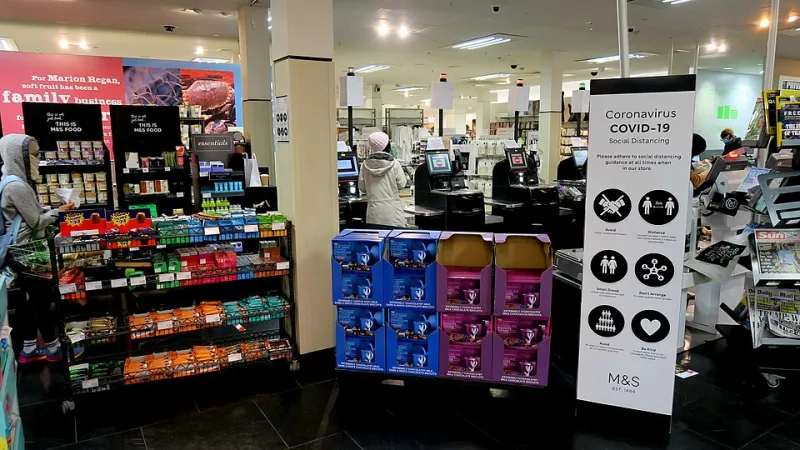
Photo: Kwh1050, CC BY-SA 4.0, via Wikimedia Commons
There is a moment, somewhere between the third beep and the first passive-aggressive sigh from the person behind you, when the supermarket self-checkout stops being a machine and becomes a theatrical event. You are the lead. The till is the villain. The bagging area is the unreliable understudy. And somewhere in the ceiling, a colleague called Sharon is watching everything on a monitor with the calm of a woman who has seen it all before.
Welcome to Britain’s most quietly stressful night out: the self-checkout panto.
The Queue Is the Warm-Up Act
Every great production needs an overture, and ours is the queue. This is not a simple line. It is a live-action puzzle in which everyone pretends not to be choosing a till while absolutely choosing a till. You spot a free machine. Someone else spots it at the same time. You do the dance: half-step forward, apologetic hand gesture, a small laugh that says “after you” while your eyes say “I have frozen peas and a train to catch.”
Then comes the ditherer. They reach the screen, pause, and stare at the options as if being asked to solve the Middle East peace process rather than confirm whether they have a Clubcard. Behind them, the queue begins to breathe in a way that is technically polite and spiritually violent.
And finally, the person who has clearly never used a self-checkout before but has decided that today, of all days, is the day to learn. They hold a cucumber like it is an unexploded device. They press “search item” with the caution of someone defusing a bomb. The rest of us stand in solidarity, united by the unspoken British belief that we could do it faster, better, and with fewer unexpected items in the bagging area.
Meet the Cast of the Checkout
Self-checkout brings out whole new personalities. First, there is the Overpacker: the shopper who believes the bagging area is a Tardis and attempts to balance a family-sized lasagne, six yoghurts and a potted basil on top of a single reusable bag. The machine protests. The Overpacker ignores it. The machine protests louder. The Overpacker adopts the expression of someone being unfairly accused of a crime they are, in fact, committing.
Then there is the Vigilante, who has memorised every PLU code for every loose vegetable and scans them with the quiet pride of a quiz champion. They tut at the rest of us. They know their onions. Literally.
And, of course, there is the Innocent Bystander, who has only come in for a meal deal and a birthday card, and who now finds themselves trapped in a small glass cage while a robotic voice asks them to “please wait for assistance” as if they have been arrested for shoplifting a Twix.
The Voice That Knows Your Sins
The self-checkout voice is a masterpiece of passive aggression. It never shouts. It never loses its temper. It simply repeats itself with the calm of a teacher who is not angry, just disappointed.
“Unexpected item in the bagging area.”
You look. There is nothing there. You move the bag. You look again. Nothing. The machine has invented a ghost. You are now being haunted by a phantom loaf.
“Please place the item in the bagging area.”
You place the item in the bagging area. The machine pauses, as if considering whether to accept your offering. Then: “Unexpected item in the bagging area.” At this point you begin to suspect the till is not malfunctioning but simply enjoying itself.
And then there is the final flourish: “Please take your receipt.” It says this as if it is a suggestion rather than a command, and yet you know that if you walk away without it, the machine will remember. It always remembers.
The Packing Shuffle Is a Contact Sport
Forget Strictly. The real footwork happens at the self-checkout. You scan a tin of beans and immediately pivot to the bag, guiding it into position with the precision of a rugby fly-half. You learn to scan with one hand while packing with the other, like a one-person production line with a deadline and a mild sense of shame.
There is a rhythm to it: beep, bag, beep, bag, glance at the queue, beep, bag, panic because the machine has gone quiet, beep, bag, apologise to the bag for squashing the crisps. It is less a shopping trip and more a cardio session performed in public. By the time you reach the end, you have burned enough calories to justify the family-sized bag of Minstrels you have just purchased.
Unexpected Item in the Bagging Area (a.k.a. Life)
The phrase itself has escaped the supermarket and entered British life. “Unexpected item in the bagging area” is now how we describe a surprise work email, a child’s forgotten PE kit, or the moment you realise you have left your phone in the fridge. It is the perfect metaphor for modern Britain: a system that is almost working, a human who is doing their best, and a machine that is not entirely convinced.
Maybe that is why we keep going back. Not because self-checkouts are convenient — they are, sort of — but because they give us a shared experience. We all know the quiet panic. We all know the fake smile. We all know the desperate wave to Sharon.
How to Exit With Dignity (Or Fake It)
The trick, as with most British rituals, is to commit. Do not apologise to the machine. Do not explain yourself to the queue. Simply scan, bag, pay, and leave with the confident stride of someone who definitely did not just try to buy a carrot as a parsnip.
And if the machine says, “Unexpected item in the bagging area,” just nod. Agree. Say “I know, love.” Then carry on. It is not real. It is just theatre. And you, my friend, are the star.