The Fried-Bread Summit: Scoring Britain’s Hotel Breakfast Buffets
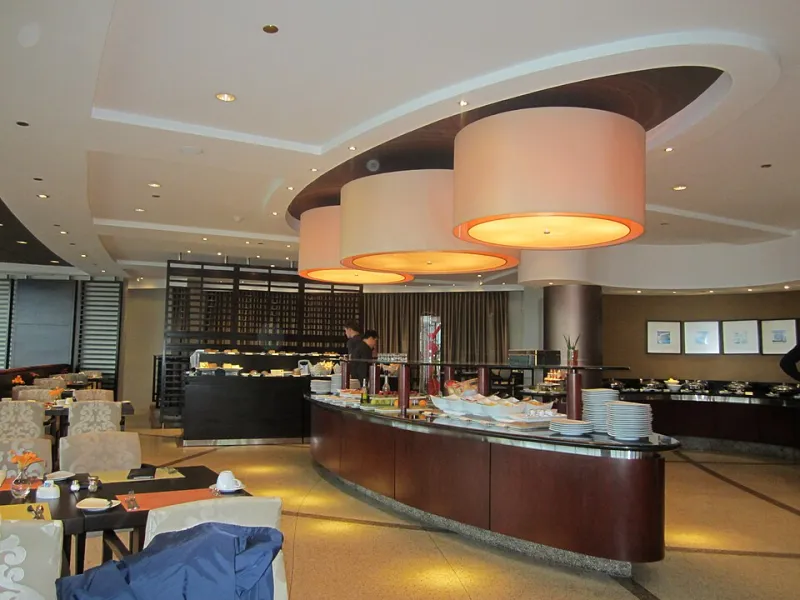
Photo: Kim, CC BY-SA 2.0, via Wikimedia Commons
The British hotel breakfast buffet is not a meal. It is a live event. There are queues, heroes, villains, moments of high drama and a surprising amount of pineapple. You arrive hopeful, clutching a plate that is slightly too warm, and leave wondering why you had beans, yoghurt and a mini muffin in that order. This is not a review of any particular hotel. It is a field guide to the buffet itself, complete with a scoring system you can deploy from behind a glass of orange juice.
The single-file sausage economy
Sausages are the currency of the British breakfast buffet. They are also the source of its deepest tensions. The tongs are shared. The queue is not. When the tray is nearly empty, a hush falls over the room. One guest will take two sausages and feel the eyes of everyone behind them. Another will take one and spend the rest of breakfast regretting it. The ideal sausage is hot, not wrinkled, and not actively fleeing the tray. Score one point for availability, one for temperature and one for the dignity of the person serving them.
The toast-machine bottleneck
Every buffet has a toast machine, and every toast machine is operated by someone who has never met a conveyor belt. You put your bread in one end. You wait. You watch it travel at the speed of a glacier. Behind you, a queue forms. Someone sighs. Someone else says, 'It's always like this.' The toast emerges pale on one side and scorched on the other, which is apparently the official specification. The Cheekie Monkey awards bonus points for a second toast machine and minus points for a sign that says 'Please do not put croissants in the toaster.'
The fried-bread fortress
There is always one guest who treats fried bread as a structural material. They do not place it; they engineer it. It becomes a base for eggs, a wall for beans, a roof for mushrooms. It is not breakfast; it is a small edible bungalow. We respect the ambition. We fear the cholesterol. A good fried-bread fortress should be admired from a safe distance and never, under any circumstances, be allowed to block access to the hash browns.
Second-visit etiquette
The first visit is reconnaissance. The second visit is judgment. The third visit is showing off. Between visits, you must return your plate to the designated trolley unless you want to become a cautionary tale. Do not take the last hash brown if you have already had three. Do not ask the staff to 'just check the kitchen' for more bacon unless you are prepared to wait with the quiet fury of a person who has already paid for breakfast. The second visit should be strategic: one item you missed, one item you genuinely want, and no more than one item you are only taking because it is there.
The Cheekie scoring system
Award points out of ten for each category: sausage integrity, toast queue management, bean containment, fried-bread audacity, available seating and staff tolerance. Total the score out of sixty. A score of 50 or above is a Full English triumph. 40 to 49 is a solid hotel breakfast. 30 to 39 is a Travelodge truce. Below 30 is full continental chaos, which means you may still be eating a croissant at 11am while a stranger guards the last sausage.
Use this system responsibly. Nobody needs a spreadsheet at breakfast, although we would secretly respect you if you brought one. The real test of a British hotel buffet is not the quality of the egg. It is whether you can leave without saying 'I've overdone it' to a complete stranger. We have all been there. The fried bread always wins.