Peri-Peri Politics: The Cheekie Monkey’s Unwritten Rulebook for a Cheeky Nando’s
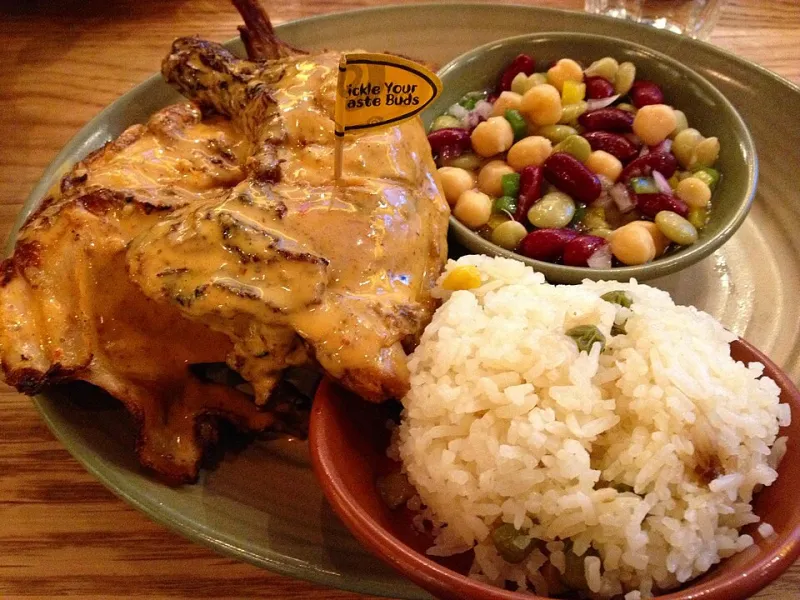
Photo: Banej, CC BY-SA 4.0, via Wikimedia Commons
There are few phrases in the British language that do so much work with so few syllables. “Fancy a cheeky Nando’s?” can be a suggestion, a confession, a peace offering, or – if delivered at 10.47pm on a Saturday – a mild cry for help. The word “cheeky” is doing an awful lot of heavy lifting here. Nobody says a cheeky Michelin tasting menu. Nobody has ever whispered about a cheeky Waitrose Essentials shop. But slap “cheeky” in front of a plate of butterfly chicken and you have somehow made an ordinary dinner sound like a minor act of rebellion.
The phrase drifted into the national vocabulary in the early 2010s, when the internet got hold of it and refused to let go. It was shared, parodied, and eventually worn down into the sort of thing your uncle says in a group chat. And yet, more than a decade on, the ritual itself survives – complete with unspoken rules, quiet hierarchies and one genuinely divisive question: what goes on the side?
The Ordering Ceremony
Going to Nando’s is not a transaction. It is a small piece of theatre. You queue – obviously you queue – and while you queue you pretend to study the menu on the wall as though you haven’t already decided exactly what you were having in the car park. This is tradition. The person who announces their full order before the queue has moved two feet is regarded with a mixture of suspicion and awe.
Then comes the table number. You are issued a small wooden block with a number on it, and for the next hour your identity is reduced to a digit. “Table fourteen?” the server will call, and eleven people will instinctively check their own table, like a fire drill.
The crucial etiquette: you do not, under any circumstances, sit at a table you did not choose at the till. The till knows. The till remembers. Attempting to relocate is a rookie error that will see your food delivered to a confused family of four in the corner while you eat a lone garlic bread in shame.
And then there’s the basting debate. Mild basting on the side? Extra basting at the table? Asking for more than two little pots is viewed, in polite society, as a tacit declaration of war on the condiment station.
The Heat Scale: A Matter of National Security
The peri-peri scale is, on paper, quite straightforward: Lemon & Herb, Medium, Hot, Extra Hot, and the occasional seasonal interloper lurking at the top like a dare. In practice, it is a personality test.
Lemon & Herb is the safe choice – the sensible shoes of the menu. Ordering it is fine, but ordering it at volume, with a straight face, does suggest a person who has never knowingly raised their heart rate. Medium is the national default: respectable, unfussy, the beige cardigan of heat levels. Hot is where the bravado begins. Extra Hot is where the bravado ends, usually about four bites in, when the confident one quietly reaches for the bottomless drink machine and starts taking the whole experience much more seriously.
There is a peculiar British ritual here, whereby someone will insist they can “take the heat”, order Extra Hot, and then spend the rest of the meal describing it as “a bit of a kick, actually” through a face the colour of a postbox. Nobody intervenes. We simply watch, politely, and ask if they’re alright every ninety seconds.
The Side-Order Schism: A Cheekie Ranking
Nowhere is the British capacity for quiet judgement better displayed than in the sides. Consider this our entirely unscientific, deeply partial ranking.
- Chips. The undisputed monarch. Fluffy, salty, structurally sound for scooping. Anyone who orders salad instead is either lying or unwell.
- Garlic bread. Not really a side. A small religious experience. Order the double and stop pretending you’re going to share.
- Spicy rice. The dependable colleague of the plate. Never exciting, never disappointing, always there in a crisis.
- Macho peas. The great ideological split. People either defend these with the ferocity of a football fan or loudly declare them “a bit weird”. There is no middle ground.
- Corn on the cob. A bold choice in public. Nobody has ever eaten one in front of a date and emerged with their dignity intact.
- Coleslaw. Virtuous, cooling, and silently judging the chips.
- Mixed leaf salad. Something to make your order feel balanced while you eat your own body weight in chicken. We see you.
The real tension arises when the table tries to go “sharing”. It is the fastest way to discover which of your friends has been concealing a ruthless streak for the last fifteen years. The chips are communal in spirit and fiercely guarded in practice. There is no cheeky way to ask someone to stop taking your garlic bread.
The Bill, the Exit and the Cheeky Aftermath
The one who pays the bill is rarely the one who ordered the most. The bill arrives, the app gets opened, and a complicated social algorithm begins, involving transfer references, approximations, and at least one person who insists they only had “a bit of the garlic bread”.
And then you leave, gently smelling of peri-peri, and someone in the group says the phrase that started it all. “That was a cheeky one.” Everyone nods. A small national ritual has been completed, and nothing more needs to be said.
So yes, cheeky by name, cheeky by nature. Just don’t be the one who tries to move tables at the till. There are limits.